

Autodesk Inventor 2025 Setup Guide | Installation and License Activation

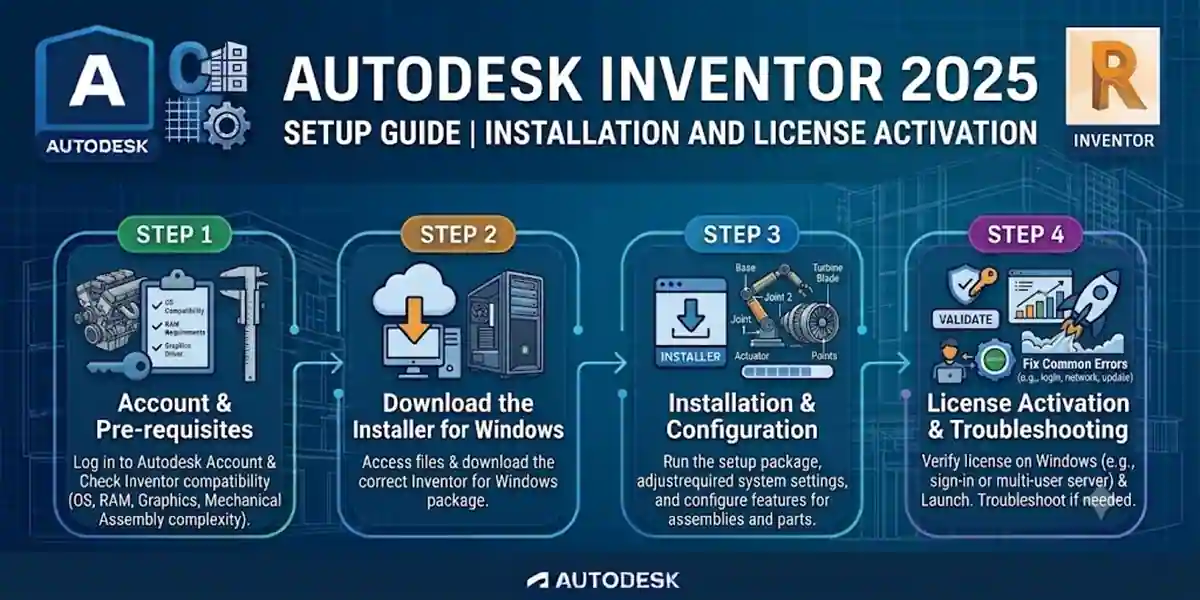
Introduction
Autodesk Inventor is one of the most popular 3D mechanical CAD tools in the world. Product designers, machine builders, and manufacturing engineers use it to model parts, build assemblies, create sheet metal designs, run simulations, and produce drawings that go straight to the shop floor. The 2025 release is a milestone version, and it brings performance work, interface improvements, and automation upgrades that make everyday design faster.
None of that helps you until the software is installed and activated. Activation is usually quick. When it fails, the cause is almost always simple: the wrong Autodesk account, a seat that was never assigned, a firewall that blocks Autodesk services, an old sign-in file, or a license server that cannot be reached. Instead of fixing the real problem, some people look for “cracks” and “activators.” Those are unsafe and illegal, and this guide does not cover them. Here you will find the official, supported ways to activate Inventor 2025, along with the commands and fixes that solve the most common problems.
What Is Inventor 2025?
Autodesk Inventor is a professional 3D CAD application for mechanical design, simulation, visualization, and documentation. It is built around parametric modeling, which means your designs are driven by dimensions, constraints, and features that you can edit at any time, and the model updates automatically.
Typical uses include:
- Machine and equipment design
- Sheet metal and weldment design
- Plastic and molded part design
- Frame and structural design
- Tube, pipe, and cable routing
- Product design and consumer goods
- Tooling, jigs, and fixtures
- Manufacturing documentation and 2D drawings
- Automation with iLogic and add-ins
Inventor Professional
Most customers use Inventor Professional, which is the full product. You may also see references to Inventor in the Autodesk Product Design & Manufacturing Collection, which bundles Inventor with other tools. Packaging changes over time, so check your own plan in your Autodesk account to see exactly what you have.
You can read Autodesk’s own description on the Inventor product page and find detailed documentation in the Inventor 2025 help.
Key Features of Inventor 2025
Knowing what you are unlocking helps you confirm that activation worked. Here are the main features worth knowing about.
A milestone release
Inventor celebrated its 25th year with the 2025 release, which includes more than 142 enhancements and more than 1,330 bug fixes. That mix of new features and stability fixes is a good reason to move to 2025 if you are on an older version.
Smarter patterns
Patterns in both the sketch and part environments can now use a boundary, so a pattern only fills a specified area. That gives you more precise control and fewer manual cleanup steps.
A modernized sheet metal environment
The sheet metal environment has been modernized, with face, flange, and cut operations moving to the new dockable system. Autodesk’s partners describe a streamlined interface that places tools in a logical order and makes previously hard-to-find features easier to access. If you design brackets, enclosures, or panels, you will notice this one quickly.
Finish feature improvements
The Finish feature arrived in 2024 and was improved in 2025. If you use Make Part, your finish features now show up in the derived part. That helps you carry coatings and surface information through your design workflow.
Oriented minimum bounding cylinder
A new Oriented Minimum Bounding Cylinder option helps simplify cylindrical envelope assemblies. This is handy when you need a simplified shape for packaging, clearance, or sharing models without exposing details.
More iLogic control
Inventor 2025 adds a new iLogic event trigger that runs rules before Vault check-in, along with new snippets for working with Model States. You can also inspect for malicious code in iLogic. If your team uses Vault for data management, these changes help enforce company rules automatically.
Better Revit and IFC interoperability
For users converting to Revit files and families, you can now send files to a specific version of Revit, which allows back-saving. You can also import Revit models going back as far as 2023. IFC support has been improved too. This matters when mechanical designers and building teams exchange models.
Drawing and table improvements
Tables in drawings now support merging cells, there is a new option for revision tables, and the styles editor has a new option for BOM sort order. These small changes save time on drawing production.
Performance Feedback Recorder
Autodesk introduced a Performance Feedback Recorder, along with graphics enhancements for better visualization. It helps users and Autodesk understand where performance problems come from.
Updates since launch
Inventor gets mid-year updates too. For example, Inventor 2025.2 added a Midpoint Line command in the 2D sketch environment, lets you double-click to edit non-active sketches, and adds a toggle in the bill of materials to hide or show rows with zero quantity. Install the latest update after you activate so you get these improvements. You can read more on the Inventor 2025.2 What’s New post and the 2024 year in review, and a partner overview is available on the Symetri What’s New in Inventor 2025 blog.
One thing to remember
All of these features need an active, correctly authenticated license. If tools are missing, if you see a trial or “not licensed” message, or if the software shuts down after a short time, activation did not finish properly.
Understanding Your License Type
Before you activate, find out which license type you have. The method depends on it.
Named-user subscription (most common)
A seat is assigned to your Autodesk ID. You sign in, and the software checks your entitlement. There is no serial number to type. This is the standard model for current releases.
Multi-user (network) license
A license server on your company network hands out seats when users launch the software. An administrator manages it with the Autodesk Network License Manager. Availability depends on your contract.
Serial number and product key (legacy)
Older perpetual licenses and some legacy agreements use a serial number and a product key that you enter during installation or activation.
Educational license
Students and educators can get a free license after verifying their eligibility. It is for learning and non-commercial work only. Learn more on the Autodesk Education page.
Free trial
Autodesk offers time-limited trials so you can test performance before you buy. Start from the free trials page.
How to Download Inventor 2025
Always download from Autodesk directly. Installers from random websites and file-sharing portals are a common way to spread malware.
- Go to the Autodesk Account and sign in.
- Open All Products and Services.
- Find Inventor Professional or the collection that includes it.
- Use the drop-down menus to choose 2025, your operating system, and your language. If 2025 is not shown at first, look for a previous versions option.
- Choose how to get it:
- Install starts the Autodesk installer right away.
- Download saves the installer to run later.
- Custom Install (where available) lets IT teams build a package with specific settings.
- Save the installer on a drive with enough free space.
The download is large, so use a stable connection.
How to Install Inventor 2025 (Step by Step)
Step 1: Prepare
Close all applications. If security software blocks the installer, you can pause it briefly, then turn it back on after installation.
Step 2: Run the installer as administrator
Right-click the installer and choose Run as administrator.
Step 3: Accept the terms
Read and accept the license and services agreement.
Step 4: Choose what to install
Select Inventor Professional 2025. Optional components may include:
- Content Center libraries for standard parts like fasteners, bearings, and structural shapes
- Language packs
- Simulation or add-in components included in your plan
- Autodesk Docs and collaboration components
- Vault integration components
Install only what you need. You can add more later.
Step 5: Choose the location
The default folder works for most people. A fast local drive improves performance. Avoid network drives.
Step 6: Install
Click Install. It can take from several minutes to over an hour depending on your computer, your connection, and the options you chose. Do not close the installer or shut down the computer.
Step 7: Finish and restart
Click Finish and restart Windows if prompted. This lets the licensing service register properly.
Step 8: Start Inventor
Open Inventor from the Start menu or desktop. On first launch you will usually see a sign-in or license prompt. The next section explains how to activate.
Installing on many computers (IT teams)
Administrators can build a deployment package in their Autodesk account and push it with tools such as Microsoft Intune or Configuration Manager (SCCM). This keeps every machine configured the same way. Test on one computer first, and make sure Content Center, templates, styles, and project files are part of the plan. For exact silent-install options, follow Autodesk’s deployment documentation and the Autodesk Support knowledge base.
Methods of Activation
Method 1: Sign In with a Named-User Subscription (Easiest)
- Launch Inventor. You should see a Sign in screen.
- Click Sign In. Your browser opens an Autodesk sign-in page.
- Enter your Autodesk ID. If your company uses single sign-on, choose that option.
- Complete multi-factor authentication if your account requires it.
- Return to the application. The browser sends the sign-in back automatically.
- Wait a moment. The software checks your entitlement and licenses itself.
- Confirm. Open Help → About or check your account area to see your product and license information.
Tips
- Use the account that holds the subscription. Signing in with a personal email when the subscription belongs to your work email is the most common cause of problems.
- Stay online for the first launch. Later, limited offline use is allowed, but the software needs to re-check your license from time to time.
- Do not share your login. Each named user should have their own account.
- If the browser does not hand the sign-in back to Inventor, try copying the sign-in link into another browser.
Signs of success: no trial banner, your name or Autodesk ID in the account area, and the ability to create parts, assemblies, drawings, and presentations without license warnings.
Method 2: Connect to a Network (Multi-User) License
Network licensing involves two roles: the administrator, who sets up the server, and the user, who connects to it.
For administrators
- Get the license file. In your Autodesk account’s licensing area, generate or download the license file for your server (usually with the server’s host name and MAC address).
- Install the Autodesk Network License Manager on the server, from Autodesk’s official download.
- Place the license file in the manager’s folder and check that the SERVER line matches your host name.
- Start the service with LMTOOLS or the manager’s configuration tool.
- Open the firewall ports for the license daemon and the vendor daemon.
- Verify with the Server Status tab and Perform Status Enquiry.
A command-line check looks like this:
lmutil lmstat -a -c 27000@YOUR-LICENSE-SERVER
Replace the port and server name with your own.
For users
- When the installer or the first-launch dialog asks about license type, choose Multi-user (network).
- Enter the server name or port@server address from your IT team.
- For redundant servers, enter the list in the order your IT team gives.
- Click Activate or Continue.
You can also set the connection with an environment variable, using an elevated Command Prompt:
setx ADSKFLEX_LICENSE_FILE "27000@YOUR-LICENSE-SERVER" /M
Restart Inventor afterward. To confirm the value in a new Command Prompt:
echo %ADSKFLEX_LICENSE_FILE%
Always confirm details with your IT team and Autodesk’s documentation for your version.
Network license tips
- Put the license server on a stable, always-on machine with a fixed IP address or DNS name.
- Write down your ports and firewall rules.
- Watch seat usage and plan for peak times.
- Keep the host name and MAC address stable, because changes can invalidate the license file.
Method 3: Serial Number and Product Key (Legacy)
Some older installations still use a serial number and a product key. Product keys are specific to each product and version. For Inventor Professional 2025 you will often see 797R1 published, but always confirm it against Autodesk’s official product key list rather than trusting a blog, including this one.
Steps
- Start the installation, or launch the trial and click Activate.
- Choose Enter a serial number.
- Type the serial number from your purchase confirmation.
- Type the product key for your product and version.
- Click Next, then Activate.
- If you are online, the software activates automatically.
If online activation fails, some legacy agreements allowed an activation-code process. Select the option for having an activation code, generate a request code, submit it through Autodesk’s official support channels, then enter the activation code you receive. This is not available for every product or agreement, so ask Autodesk Support or your reseller what applies to you.
Reminders
- The serial number and product key must match the product and version.
- A key from another year or product causes an invalid key error.
- Collection keys do not work for single products, and vice versa.
Method 4: Education License
Eligible students and educators can use Inventor for learning at no cost.
- Create or sign in to your Autodesk account.
- Verify your status in the Autodesk Education area.
- Find Inventor Professional and install it from your account.
- Launch it and sign in with the same account.
Notes: education licenses usually run for a set period, such as a year, and can be renewed while you remain eligible. Output may be marked as educational, and commercial use is not allowed.
Method 5: Turn a Trial into a Full License
If you started with a trial, you do not need to reinstall.
- Make sure your subscription is active and assigned to your Autodesk ID.
- Open Inventor.
- Sign out of the trial account if prompted, then sign in with the subscription account.
- Restart the application if asked.
- Check that the trial banner is gone.
If it remains, confirm that you installed the same product and version that your subscription covers.
Method 6: Autodesk Licensing Helper (Command Line, for IT)
Autodesk installs a licensing service and a command-line helper. IT administrators use it to check status and switch license types. The path and options can vary by version, so check Autodesk’s documentation first.
Common location:
C:\Program Files (x86)\Common Files\Autodesk Shared\AdskLicensing\Current\helper\AdskLicensingInstHelper.exe
List products and license settings
AdskLicensingInstHelper.exe list
Switch to named-user licensing
AdskLicensingInstHelper.exe change --pk PRODUCT_KEY --pv PRODUCT_VERSION --lm USER
Switch to network licensing
AdskLicensingInstHelper.exe change --pk PRODUCT_KEY --pv PRODUCT_VERSION --lm NETWORK --ls 27000@YOUR-LICENSE-SERVER
Notes: use the exact key and version shown by the list command, run from an elevated Command Prompt, test on one machine first, and keep a record of the original settings.
Helpful Commands for Checking and Fixing Licensing
Inventor does not use AutoCAD-style command-line entries, so most licensing fixes use standard Windows commands and Autodesk’s helper. Run them in an elevated Command Prompt or PowerShell unless noted.
Check that the Autodesk licensing service is running
sc query AdskLicensingService
If it is not running, start it:
net start AdskLicensingService
Restart it if needed:
net stop AdskLicensingService

net start AdskLicensingService
You can also press Windows + R, type services.msc, and look for Autodesk Desktop Licensing Service. Set it to Automatic. Service names can differ slightly between builds.
Reset the stored sign-in state
Close all Autodesk applications first, then run:
del "%localappdata%\Autodesk\Web Services\LoginState.xml"
Restart Inventor and sign in again.
Check whether Inventor is still running in the background
A crashed Inventor sometimes leaves a process behind, which can block a new session or hold a seat.
tasklist | findstr /i "Inventor"
If you see a stuck process and the program is not responding, you can end it:
taskkill /im Inventor.exe /f
Use this only when Inventor is frozen, and save your work elsewhere if you can.
Fix the system clock
w32tm /resync
Test your connection
ping www.autodesk.com
nslookup accounts.autodesk.com
Flush the DNS cache
ipconfig /flushdns
Check the proxy
netsh winhttp show proxy
Check your Windows version
winver
Repair damaged Windows files
sfc /scannow
If that finds problems it cannot fix, run:
DISM /Online /Cleanup-Image /RestoreHealth
List installed Autodesk programs (PowerShell)
Get-Package -Name "*Autodesk*"
This helps you spot leftover or conflicting installations, including older Inventor versions.
Check the network license variable
echo %ADSKFLEX_LICENSE_FILE%
Troubleshooting Errors and Fixes
1. “Product is not licensed” or “Your license is no longer valid”
Why it happens: wrong account, expired subscription, no seat assigned, or a corrupt login state.
How to fix it:
- Sign out and sign in with the account that holds the subscription.
- Check your Autodesk account to confirm the product is assigned and the subscription is active.
- Ask your admin to assign or reassign your seat.
- Look for a billing problem that paused the subscription.
- Delete LoginState.xml using the command above and try again.
2. Sign-in loop or the browser does not return to Inventor
Why it happens: browser settings, blocked pop-ups, cookies, or a stale login file.
How to fix it:
- Set a different browser as default and retry.
- Clear cookies and cache for Autodesk websites.
- Close Inventor, delete the login state file, and sign in fresh.
3. Licensing errors in the 0015 family (such as 0015.111 or 0015.426)
Autodesk uses codes starting with 0015 for licensing problems. The meaning varies, so look up your code on Autodesk Support. Common fixes:
- Make sure the licensing service is running (sc query AdskLicensingService, then net start AdskLicensingService).
- Repair or reinstall the licensing component from Autodesk’s official source.
- Update Windows and check that security software is not blocking the service.
- Use AdskLicensingInstHelper.exe list to review the license configuration.
4. “License manager is not functioning or is improperly installed”
This appears with network or legacy licensing.
How to fix it:
- Make sure the license server is running and reachable.
- Check the ADSKFLEX_LICENSE_FILE variable and verify the server name and port.
- Open the firewall ports for the license and vendor daemons.
- Run lmutil lmstat -a -c 27000@YOUR-LICENSE-SERVER to confirm features are available.
- Restart the license manager service and the client.
5. “No licenses available” or “All licenses are in use”
Why it happens: in a network setup, all seats are checked out.
How to fix it:
- Ask users to close the software when they are finished.
- Check who holds seats with LMTOOLS or lmutil lmstat.
- Consider adding seats if it keeps happening.
- Look for stale sessions after a crash. Check for stuck Inventor processes with tasklist, or restart the machine or the license service to free the seat.
6. “Serial number or product key is invalid”
How to fix it:
- Re-check the numbers for typing mistakes.
- Confirm that the product key matches your product and version.
- Make sure you are not using a key from another year, product, or a collection.
- Contact Autodesk Support with your proof of purchase.
7. Inventor goes back to trial mode after a restart
Why it happens: profile resets, cleaning utilities, virtual desktops, or permission problems.
How to fix it:
- Make sure the user can write to the licensing data folders.
- Exclude Autodesk licensing folders from cleaning and disk-reset tools.
- In virtual desktops, use a licensing method designed for them and read Autodesk’s guidance.
8. Installation fails or hangs
How to fix it:
- Run the installer as administrator.
- Free up disk space and restart Windows.
- Remove leftovers from failed installs with Autodesk’s official uninstall tools.
- Repair Microsoft Visual C++ and .NET components.
- Run sfc /scannow.
- Pause conflicting security software briefly.
- Check the installer log files in your temporary folder.
9. “Unable to connect to the Autodesk licensing server”
How to fix it:
- Test your connection and open Autodesk’s sign-in page in a browser.
- Run ping www.autodesk.com and nslookup accounts.autodesk.com.
- Check the proxy with netsh winhttp show proxy.
- Allow Autodesk domains through your firewall.
- Check the date and time, and run w32tm /resync.
- Try a different network, such as a mobile hotspot, to rule out company restrictions.
10. Inventor opens, but features or libraries are missing
Why it happens: optional components were not installed, or the plan does not include the feature.
How to fix it:
- Open Apps and features, select the Autodesk Inventor entry, and choose Modify to add missing components such as Content Center libraries.
- Check your plan in your Autodesk account.
- Confirm that you installed Inventor Professional and not a different product.
11. Inventor 2025 does not appear in my Autodesk account
How to fix it:
- Look for a previous versions link on the download page.
- Ask your administrator whether your plan includes access to that version.
- Contact Autodesk Support or your reseller if it is not offered.
12. Inventor crashes or freezes on startup
This is not always a licensing problem, but it often shows up after a fresh install.
How to fix it:
- Update your graphics driver from the GPU maker.
- Install the latest Inventor 2025 update.
- Temporarily disable overlay software, such as screen recorders, that hooks into graphics.
- Check the Windows Event Viewer for errors from the time of the crash.
- Repair the installation from Apps and features.
- If the problem remains, use the Performance Feedback Recorder and Autodesk Support to help identify the cause.
13. Content Center is empty or will not connect
How to fix it:
- Run the installer’s Modify option and add the Content Center libraries.
- Check your project file and Content Center settings to make sure they point to the correct library locations.
- If you use a shared Content Center on a server, confirm that the server is reachable and the user has permission.
14. Vault login or check-in problems
Vault issues are separate from Inventor licensing, but they often appear together.
How to fix it:
- Confirm that your Vault client version matches your Vault server version and your Inventor version.
- Check your network connection and the server address.
- Make sure your Vault user account is active.
- If your iLogic rules run before check-in, review the rules for errors, because a failing rule can block the check-in.
15. Problems opening files from older versions
How to fix it:
- Make a copy of the files first.
- Open the top-level assembly and let Inventor upgrade the referenced files, or use the Task Scheduler for batch upgrades.
- Check the upgraded files carefully before you replace the originals, since upgraded files cannot normally be opened in older versions.
16. Problems after a Windows upgrade or new hardware
How to fix it:
- Sign out and back in.
- Review the license setup with the helper tool.
- If necessary, repair or reinstall the licensing service and Inventor.
Managing Your License After Activation
Moving to a new computer. Named-user licenses typically allow installation on a limited number of devices, with one active session at a time. Install on the new PC and sign in. If you hit a limit, sign out on the old machine or use your account’s management page.
Managing seats as an administrator. In your Autodesk account you can assign and unassign users and review usage. Reassign seats promptly when someone leaves.
Renewals. Set a reminder before renewal. A lapsed subscription deactivates the software at the next license check, which could interrupt a project.
Records. Keep your contract number, subscription details, legacy serial numbers, and administrator contacts in a safe place.
Conclusion
Activating Autodesk Inventor 2025 is simple once you have the right license and follow the right steps. For most people, it comes down to downloading the software from their Autodesk Account and signing in with the account that holds their subscription. Larger organizations may connect to a network license server, and some legacy installations still use a serial number and product key.
To recap:
- Confirm your plan and make sure Inventor (or a collection that includes it) is assigned to you.
- Download only from Autodesk, and install with administrator rights.
- Activate by signing in, connecting to a network license, entering legacy credentials, or using a verified education account.
- Use the licensing helper and standard Windows commands to check and repair your setup.
- Fix errors one step at a time: check the account, the licensing service, the network, and the license server.
- Avoid cracks, unofficial activators, and “lifetime license” offers that look too good to be true.
With the software activated, you can use the improved patterns, the modernized sheet metal tools, the new iLogic triggers, better Revit and IFC exchange, and the updates that arrive through the year. A properly licensed copy gives you updates, support, and peace of mind, which matter when your models turn into real parts. If you have followed these steps and still cannot activate, contact Autodesk Support with your account email, product and version, operating system, and the exact error message.
Frequently Asked Questions (FAQs)
Install Inventor 2025 from your Autodesk Account, launch it, click Sign In, and enter the Autodesk ID that holds your subscription. The software validates your entitlement and activates automatically. Legacy installations may need a serial number and product key, and network licenses connect to a license server.
For named-user subscriptions you normally do not. You sign in with your Autodesk ID. Serial numbers and product keys apply to legacy installations and some older agreements.
The key commonly published is 797R1, but product keys are specific to each product and version. Confirm it against Autodesk’s official product key list before using it.
Highlights include boundary options for patterns, a modernized sheet metal environment, finish feature improvements, an oriented minimum bounding cylinder option, new iLogic triggers, better Revit and IFC interoperability, and table cell merging. Autodesk’s partners also describe more than 142 enhancements and more than 1,330 bug fixes in the release.
The usual causes are using the wrong account, no seat assigned to you, an expired subscription, or a stale login state. Sign out, sign in with the right account, check your assignments, and if necessary delete LoginState.xml and try again.
Named-user licenses allow limited offline use after you sign in, but the software must reconnect to Autodesk periodically. Network licenses need access to the license server. For long offline periods, ask your reseller about your options.