

Autodesk Fusion 2020 The Ultimate Setup & Feature Manual


Introduction
Modern digital product design, mechanical engineering, and additive manufacturing rely on visual tools to turn complex geometric ideas into reality. Autodesk Fusion 2020 (formerly known as Fusion 360) represents a pivotal milestone in cloud-based CAD, CAM, CAE, and PCB software. By unifying 3D modeling, generative design, electrical engineering, structural simulation, and computer-aided manufacturing into a single platform, Fusion 2020 revolutionized how designers, engineers, students, and machinists collaborate.
This comprehensive master guide covers everything you need to know about Autodesk Fusion 2020: core architectural features, licensing frameworks, step-by-step activation methods, essential keyboard and ShapeSheet commands, troubleshooting fixes for common errors, and professional workflow optimization.
What Is Autodesk Fusion 2020?
Autodesk Fusion 2020 is a unified, cloud-connected parametric and direct 3D modeling platform built to manage the full product development lifecycle. Unlike legacy desktop-bound CAD tools that require isolated files and disconnected plugins, Fusion 2020 integrates all design and manufacturing stages inside a single environment.
[ Ideation & Concept Skits ] ➔ [ Parametric 3D Solid / Surface Modeling ]

                                                │

                                                ▼

[ CAM Toolpath Generation ] ◄─── [ Structural & Thermal Simulation ]

               │

               ▼

[ CNC Machining / 3D Printing Output ]
The system uses named-user cloud licensing, allowing you to sign in from any compatible machine and access your project data, custom workspaces, rendering assets, and tool libraries instantly.
Key Features & Core Capabilities
Autodesk Fusion 2020 offers a broad set of design, simulation, and manufacturing features.
                  ┌────────────────────────────────────────┐

                  │      AUTODESK FUSION 2020 ENGINE       │

                  └───────────────────┬────────────────────┘

                                      │

     ┌──────────────────┬─────────────┼──────────────┬──────────────────┐

     ▼                  ▼             ▼              ▼                  ▼

[ Parametric &    [ Generative   [ Integrated   [ CAM 2.5D–5-Axis  [ ECAD & PCB   ]

  Direct CAD ]      Design ]       CAE Sim ]      Machining ]        Design ]
1. Integrated CAD: Parametric, Freeform, & Surface Modeling
Fusion 2020 eliminates the divide between freeform organic design and rigid history-based engineering:
Parametric Modeling: Driven by dimension variables, sketches, constraints, and timeline feature history. Edit an early extrude height, and the entire assembly updates dynamically.
T-Spline Freeform (Sculpt Workspace): Push and pull push-pins, edges, and faces to create smooth, organic surfaces while maintaining mathematical continuity.
Direct Modeling: Modify non-native STEP or IGES files without needing an underlying feature history tree—ideal for rapid geometry cleanup.
2. Generative Design Engine
Powered by Autodesk Cloud Graphics and Machine Learning, Generative Design explores thousands of CAD variations based on real-world constraints:
Input operational loads, keep-out zones, material choices, and manufacturing methods (e.g., 5-axis milling or metal 3D printing).
Generates optimized lightweight structural designs that lower weight while maintaining structural strength.
3. CAE Simulation Workspaces
Validate mechanical integrity prior to manufacturing to minimize physical prototyping costs:
Static Stress & Modal Frequencies: Analyze structural yield thresholds and resonant vibration modes.
Thermal & Thermal Stress Analysis: Model heat dissipation across electrical enclosures and engine components.
Non-Linear Stress & Event Simulation: Simulates impact tests, snap-fits, drop tests, and non-linear material deformation.
4. Computer-Aided Manufacturing (CAM)
From rapid prototyping to industrial production floor control, Fusion 2020 features native toolpath generation:
2.5D & 3D Milling: Adaptive Clearing strategies reduce cycle times while preserving tool life.
5-Axis Machining: Advanced multi-axis toolpaths for complex aerospace and medical parts.
Additive Manufacturing: Slice FDM 3D printer files directly inside your workspace with custom infill configurations.
5. ECAD & PCB Integration
Collaborate smoothly across mechanical and electrical engineering disciplines:
Design schematics, route multi-layer printed circuit boards (PCBs), and run signal integrity simulations inside the exact same project environment.
Interference fit-checks identify collisions between components, heat sinks, and outer plastic enclosures before manufacturing.
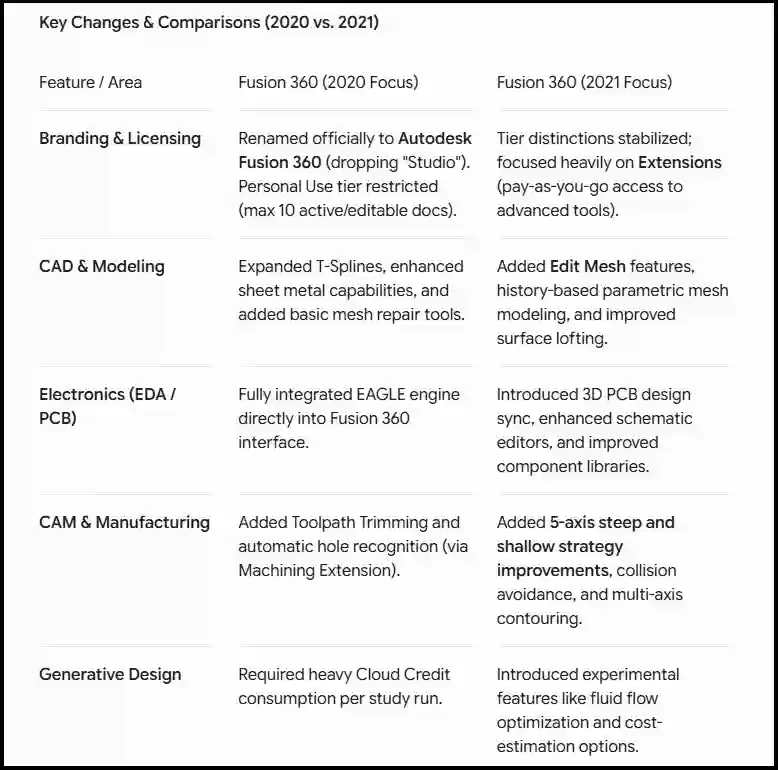
Autodesk Fusion 2020 License Types Explained
Selecting the right subscription tier ensures software compliance while unlocking the appropriate set of cloud tools.
┌────────────────────────────────────────────────────────────────────────┐

│                        AUTODESK FUSION LICENSES                        │

└───────────────────────────────────┬────────────────────────────────────┘

                                    │

    ┌───────────────────┬───────────┴───────────┬────────────────────┐

    ▼                   ▼                       ▼                    ▼

[ Commercial ]   [ Personal / Free ]   [ Startup License ]   [ Educational ]

 Full commercial   Hobbyist access       Early-stage biz       Students & Staff

 rights & CAM      (10 active docs)      (< $100k revenue)     (1-Yr renewable)
Commercial Paid Subscription: Grants full commercial rights, unlimited active document editing, advanced 5-axis CAM strategies, and access to extension modules.
Personal / Hobbyist License: Free tier for individuals working on non-commercial home projects. Limits active editable documents to 10 at a time and caps 3D CAM operations to 3-axis toolpaths.
Startup License: Designed for early-stage businesses earning less than $100k in annual gross revenue. Requires an approval application through Autodesk's startup portal.
Educational (Student & Educator) Entitlement: Grants full software access for 1 renewable year to verified students, faculty members, and academic institutions.
Step-by-Step Activation Methods
Activating Autodesk Fusion 2020 relies on a cloud single-sign-on (SSO) authentication pipeline. Follow these step-by-step methods based on your access license.
1.Sign Up or Log Into Autodesk Account:Prerequisite Step.
Navigate to the official Autodesk Account Portal online. Create a new profile or log into your existing Autodesk account credentials.
2.Download the Desktop Client:Installation Step.
Download the light installer launcher (Fusion360ClientInstaller.exe for Windows or .dmg for macOS). Run the installer with administrative privileges to configure dependencies.
3.Initial Single Sign-On (SSO) Launch:Authentication Step.
Launch Fusion 2020. The application opens a web browser sign-in window. Enter your registered account email and password to connect your desktop client to your Autodesk cloud account.
4.Verify & Assign License Entitlement:Activation Step.
Once signed in, click your user profile avatar in the upper right corner of the canvas. Select Preferences > Account to verify your active entitlement state (Commercial, Personal, Education, or Startup).
Method A: Activating Commercial Subscriptions
If your company purchased seats via an Autodesk Partner or the online store:
Log into your account as an Administrator.
Select User Management > By User from the left navigation panel.
Assign the assigned subscription seat to your team member's email address.
Have the user sign into Fusion 2020 using their email credentials. The software will automatically convert from trial mode to a commercial license.
Method B: Activating Free Student / Educator Licenses
Go to the Autodesk Education Portal.
Upload accepted verification proof (e.g., student ID card, official transcript, or faculty employment letter).
Once approved by SheerID verification, open Fusion 2020 on your computer.
Sign in with the verified email address. The top bar banner will update from "Trial" to "Education License".
Advanced ShapeSheet Formulas & Data Parameters
Fusion 2020 uses parametric equations inside its User Parameters window to automate complex assemblies.
Excel
' Dynamic Shell Thickness linked to Height variable

Shell_Thickness = User_Height * 0.05


' Conditional Screw Length Selection Logic

Bolt_Length = IF(Plate_Thickness > 10 mm, 25 mm, 15 mm)


' Automated Pattern Spacing calculation

Pattern_Spacing = (Total_Width - (Margin_Left * 2)) / (Instance_Count - 1)
By linking parameter equations across sketches, extrusions, and assembly joints, modifying a single value automatically updates your entire design model without breaking references.
Troubleshooting Common Autodesk Fusion 2020 Errors
Software execution problems can happen due to network drops, corrupted local login caches, or licensing service conflicts. Below are proven troubleshooting solutions for common issues.
┌─────────────────────────────────────────────────────────────────────────┐

│                    COMMON SYSTEM ERROR RESOLUTIONS                      │

└────────────────────────────────────┬────────────────────────────────────┘

                                     │

    ┌────────────────────┬───────────┴───────────┬────────────────────┐

    ▼                    ▼                       ▼                    ▼

[ License Verification ] [ Desktop Licensing  ]  [ Clock/Time Zone ]  [ GPU Canvas  ]

  Clear Login Cache      Service Re-install       Sync Windows/Mac     Switch Engine

  and Sign Out  AdskLicensing       System Clocks  to Direct3D9
1. Error: "License Verification Failed" or Sign-In Loops
Cause: Conflict caused by concurrent logins on multiple machines using the same account, or a stale offline security token.
Solution:
Close Fusion 2020 entirely.
Navigate to %localappdata%\Autodesk\Web Services on Windows (or ~/Library/Application Support/Autodesk/Web Services on Mac).
Delete the LoginState.xml file.
Relaunch Fusion 2020 and sign in with your account email.
2. Error: "Licensing Error / AdskLicensing Service Not Running"
Cause: The background licensing daemon (AdskLicensingService) failed to launch or became corrupted.
Solution:
Open Windows Services (services.msc).
Scroll down to Autodesk Desktop Licensing Service.
Right-click and select Restart. If the service is missing, download and reinstall the latest AdskLicensing installer from the Autodesk Technical Support site.
3. Error: "System Clock Discrepancy / SSL Certificate Failures"
Cause: Cloud security handshake fails if your computer's system clock deviates significantly from global UTC time.
Solution: Open your operating system's Date & Time settings and turn on Set Time Automatically and Sync Now.
4. Graphic Canvas Blank, Glitching, or Black Screen
Cause: Incompatible display drivers or graphics card switching conflicts on laptops.
Solution:
Open Fusion Preferences (Avatar > Preferences > General).
Set Graphics API from Auto-Detect to DirectX 11 (Windows) or Metal (macOS).
Turn off Auto-Limit graphics performance to maintain smooth viewports.
Conclusion
Autodesk Fusion 2020 remains a landmark release in the evolution of cloud-integrated product development. By unifying parametric solid modeling, freeform T-Spline sculpting, structural CAE simulation, PCB layout design, and multi-axis CAM manufacturing under a single software suite, it permanently changed how engineers, machinists, and designers turn concepts into physical products.
Whether you are configuring an enterprise-wide commercial setup, setting up an educational license for academic research, or leveraging the free hobbyist tier for home projects, executing a clean installation and proper license assignment is key to a smooth workflow. By utilizing the keyboard shortcuts, ShapeSheet parameter formulas, setup procedures, and troubleshooting fixes outlined in this guide, you can eliminate technical roadblocks, optimize your design pipeline, and maximize the full power of Autodesk Fusion 2020.
Frequently Asked Questions (FAQs)
Yes, Fusion 2020 features a built-in Offline Mode that allows you to work without an active internet connection for up to 14 consecutive days. During this period, you can edit and create designs locally. After 14 days, the desktop client must connect to the internet to re-validate your account credentials, renew your security token, and synchronize your local changes with your Autodesk Cloud Hub.
Your project data is tied to your unique Autodesk Account ID, not your local software installation. When your 30-day trial expires, simply purchase a commercial subscription or apply for an Educational/Personal license using the exact same email address. Once the new entitlement is assigned to your account, sign into Fusion 2020; your software will automatically update its license status, and all your cloud folders, files, and workspace settings will remain intact.
While both versions share the core CAD modeling engine, the free Personal License carries specific operational limits:
Limited to 10 active (editable) documents at a time (other files become read-only until toggled).
CAM capabilities are capped at 2.5D and basic 3-axis milling (no multi-axis, rapid positioning, or automatic tool changes).
Export options for certain commercial file formats (like IGES, STEP, or native CAD) are restricted.
Excludes cloud-rendering rendering queues and advanced CAE simulation extensions.
For 3D Printing: Right-click the top-level component in your design tree, select Save as Mesh, and choose your output format (STL, OBJ, or 3MF). You can also send the file directly to your preferred slicing software (such as PrusaSlicer or Cura).
For CNC Machining: Switch to the Manufacture Workspace, set up your stock boundaries and toolpaths, then click Post Process to generate machine-specific G-code files (
.nc,.tap, or.gcode).
Sign-in loops are typically caused by corrupted local authentication tokens. To fix this:
Close Autodesk Fusion 2020 completely.
Open your system's file explorer and navigate to the local web services directory:
Windows:
%localappdata%\Autodesk\Web ServicesmacOS:
~/Library/Application Support/Autodesk/Web Services
Delete the file named
LoginState.xml.Relaunch Fusion 2020 and re-enter your Autodesk account credentials.
Yes. Fusion 2020 uses Named-User Licensing, allowing you to install the application on as many computers as you need (e.g., your office workstation, home desktop, and laptop). However, you can only be signed in and actively running the application on one machine at a time under a single user account.